
OSHA Standards Cheat Sheets
For Safety Managers
Quick-reference guides, penalty tables, and compliant PPE recommendations for the standards most likely to affect your worksite so you can keep crews compliant and audits stress-free.

Why Safety Managers Need a Cheat Sheet
OSHA administers over 2,000 standards across general industry (29 CFR 1910) and construction (29 CFR 1926). No safety manager has them all memorized and the penalties for non-compliance are significant. OSHA’s ten most-cited standards consistently account for the majority of all workplace violations issued each year. The good news: a large proportion of those citations are preventable with the right PPE, proper documentation, and consistent inspection habits.
This guide is organized into individual cheat sheets, one per major standard category. Each includes a plain-English summary of what the standard requires, a compliance table, common citations managers miss, and links to compliant products.
|
⚠️ Important: This guide is a practical field reference, not legal advice. Always consult the official standards at osha.gov and your legal or EHS counsel for site-specific compliance determinations. |
OSHA Penalty Structure at a Glance
OSHA penalty amounts are adjusted annually for inflation. The figures below reflect 2024 levels and apply per violation, per day for ongoing violations.
|
Violation Type |
Per-Violation Fine |
Max (Willful/Repeat) |
|
Other-Than-Serious |
Up to $16,131 |
N/A |
|
Serious |
$1,000–$16,131 |
N/A |
|
Willful or Repeat |
$16,131–$161,323 |
$161,323 per violation |
|
Failure to Abate |
$16,131 per day |
— |
|
Posting Requirements |
Up to $16,131 |
N/A |
|
? Key insight: Willful violations — where OSHA proves the employer knew about the hazard and did nothing — carry fines up to 10x higher than serious violations. Documented PPE programs and training records are your best defense. |
|
CHEAT SHEET 1 · Personal Protective Equipment (PPE) | 29 CFR 1910.132 / 1926.28 |
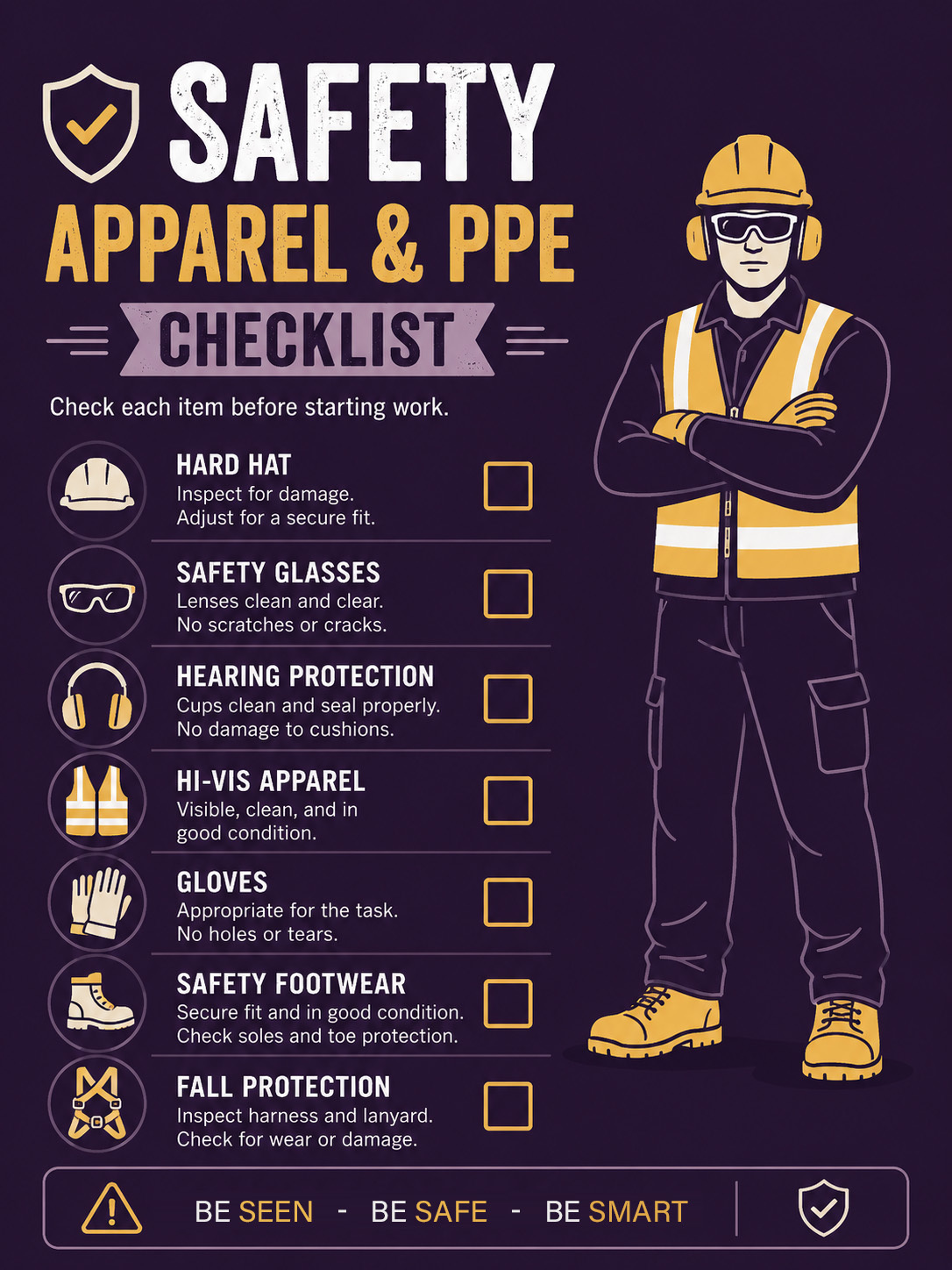 The PPE standard is one of OSHA’s most-cited regulations every year and it’s the legal backbone for almost every other PPE requirement on this list. 1910.132 (general industry) and 1926.28 (construction) require employers to assess workplace hazards, provide appropriate PPE at no cost to workers, and ensure it’s properly used and maintained.
What the Standard Requires
- Written hazard assessment of the workplace, certified by a responsible person, identifying PPE needed by task
- Employer pays for PPE in most cases (limited exceptions for everyday clothing and non-specialty footwear)
- PPE must meet the applicable ANSI/ISEA performance standard for its category
- Training required: when PPE is necessary, how to wear/don/doff correctly, limitations, useful life, and care
- Retraining required if worker behavior shows inadequate understanding or workplace hazards change
- Damaged or defective PPE must be removed from service immediately
Master PPE Compliance Table
|
Standard |
Who It Covers |
Key PPE / Apparel Required |
Max Penalty |
|
1910.135 |
Workers near falling objects or electrical hazards |
Hard hats — ANSI Z89.1 Type I or II, Class C/E/G |
$16,131 |
|
1910.133 |
Eye/face exposure: impact, chemical, optical radiation |
Safety glasses, goggles, face shields — ANSI Z87.1 |
$16,131 |
|
1910.136 |
Foot hazards: crush, puncture, electrical, chemical |
Safety footwear — ASTM F2412/F2413 |
$16,131 |
|
1910.138 |
Hand hazards: chemical, cut, thermal, electrical |
Task-appropriate gloves — rated per hazard type |
$16,131 |
|
1910.95 |
Noise at/above 85 dB 8-hr TWA |
NRR-rated earplugs or earmuffs |
$161,323 |
|
1910.134 |
Airborne hazards: dust, fumes, vapors, oxygen deficiency |
NIOSH-approved respirator + written program |
$161,323 |
|
1910.132 |
All body/skin hazards not covered by specific standards |
FR, chemical-resistant, cut-resistant apparel |
$161,323 |
Common PPE Citations to Avoid
- Missing or undated hazard assessment. OSHA requires a written, certified assessment — a verbal walk-around doesn’t satisfy this.
- Non-ANSI-rated PPE. Generic safety glasses or uncertified gloves do not satisfy the standard even if they “look like” PPE.
- No training records. Training must be documented; an inspector will ask for sign-in sheets or certificates.
- Expired or damaged PPE in service. Hard hats older than 5 years (from first use) or with visible cracks must be replaced.
Shop Compliant PPE
› Head Protection — Hard Hats & Liners — ANSI Z89.1 hard hats; FR and standard hard hat liners for cold weather
› Eye & Face Protection — ANSI Z87.1 safety glasses, goggles, and face shields
› Hand Protection — Gloves — Cut-resistant, chemical, disposable, and FR-rated gloves
› Hearing Protection — NRR-rated earplugs and earmuffs for OSHA 1910.95 compliance
› Disposable Coveralls — Chemical and particulate protection; SMS and microporous options
› Knee Pads & Back Support — Ergonomic PPE for physical strain and repetitive motion tasks
› All PPE — Full PPE catalog — head to toe
|
CHEAT SHEET 2 · High-Visibility Safety Apparel | 23 CFR 634 / ANSI/ISEA 107 / MUTCD |
Workers in roadway environments are required by federal law — 23 CFR Part 634 (FHWA) — to wear ANSI/ISEA 107-compliant high-visibility apparel at all times within the right-of-way on Federal-aid highway projects. The MUTCD extends this to virtually all public road work. Many states have supplemental requirements, and OSHA 1926.201 governs flagging operations specifically.
ANSI Class Quick Reference
|
Standard |
Who It Covers |
Key PPE / Apparel Required |
Max Penalty |
|
ANSI Class 1 |
Low-risk, separated from traffic <25 mph |
Enhanced visibility vest, tee, or jacket |
State DOT / contract |
|
ANSI Class 2 |
Moderate risk, roadway work or complex backgrounds |
Class 2 vest, shirt, hoodie, or jacket |
$16,131 |
|
ANSI Class 3 |
High-speed roads, active travel lanes, heavy equipment |
Class 3 vest, coverall, jacket, or shirt |
$16,131 |
|
ANSI Class E |
Lower body; worn with Class 2 or 3 top |
Hi-vis pants, bibs, or rain pants |
Contract / DOT |
|
Type P |
Public safety (police, fire, EMS) |
Public safety vest with ANSI + badge/weapon access |
Agency policy |
|
FR Hi-Vis |
Roadway workers near electrical/flame hazards |
FR + ANSI compliant combo garment |
$161,323 |
What Safety Managers Most Often Miss
- Rain gear must be ANSI-rated. A standard yellow rain jacket does not satisfy 23 CFR 634 unless it carries an ANSI 107 Class 2 or 3 certification label.
- Vests worn over non-FR clothing in arc-flash zones. Workers near electrical hazards need FR hi-vis — an ANSI Class 2 mesh vest over a polyester shirt is a compliance and safety failure.
- Faded or washed-out garments. ANSI 107 includes performance requirements for color retention. Visibly faded hi-vis must be replaced.
- Class E missing for equipment operators. Workers driving equipment on active roadways often still require Class E lower-body hi-vis.
Shop Compliant Hi-Vis
› ANSI Class 2 Safety Vests — Mesh, solid, surveyor, and breakaway styles
› ANSI Class 3 Safety Vests — Full-coverage vests for active travel lane work
› Class 3 Rain Jackets — ANSI 107-rated waterproof jackets for roadway workers
› FR Hi-Vis Clothing — Combined arc flash + ANSI Class 2/3 hi-vis for utility and electrical workers
› Hi-Vis Pants & Class E Rain Gear — Lower-body Class E compliance; pairs with any Class 2/3 top
› Public Safety Vests — Type P options for law enforcement, fire, and EMS
› All High Visibility Clothing — Full hi-vis catalog by class, style, and application
|
CHEAT SHEET 3 · Flame Resistant (FR) Clothing | OSHA 1910.269 / NFPA 70E / NFPA 2112 |
FR clothing requirements are governed by a combination of OSHA regulations and NFPA consensus standards. OSHA 1910.269 (Electric Power Generation, Transmission, and Distribution) mandates FR as the outer layer for utility workers near electric arcs or flames regardless of whether a formal arc flash study has been completed. OSHA 1910.132 requires FR for any worker whose hazard assessment identifies thermal hazard exposure.
The Two FR Standards Safety Managers Must Know
|
NFPA 70E — Arc Flash Protection Defines 4 PPE Categories (1–4) based on incident energy (cal/cm²). Requires arc-rated clothing with an ATPV rating at or above the calculated incident energy. Category 1 = 4 cal/cm² min; Category 4 = 40 cal/cm² min. Required for all work on or near energized electrical equipment. |
|
NFPA 2112 — Flash Fire Protection Governs garments protecting against industrial flash fires (oil & gas, chemical, petrochemical). Garments must self-extinguish within 2 seconds. Does NOT automatically satisfy arc flash requirements. Workers in dual-hazard environments need garments certified to BOTH standards. |
FR Compliance Table by Industry
|
Standard |
Who It Covers |
Key PPE / Apparel Required |
Max Penalty |
|
1910.269 |
Electric utility workers near energized systems |
FR outer layer; ASTM F1506 arc-rated garments |
$161,323 |
|
NFPA 70E Cat. 1 |
Electricians; low-energy work (≤1.2 kV) |
4 cal/cm² rated shirt + pants |
$161,323 |
|
NFPA 70E Cat. 2 |
Distribution switching, panel work |
8 cal/cm² coverall or shirt/pant system |
$161,323 |
|
NFPA 70E Cat. 3 |
Substation work, medium voltage |
25 cal/cm² arc suit or multi-layer system |
$161,323 |
|
NFPA 2112 |
Oil & gas, refinery, petrochemical workers |
NFPA 2112-certified shirt, pants, or coverall |
$161,323 |
|
1910.132 (FR) |
Any worker with documented thermal hazard |
FR apparel appropriate to assessed hazard level |
$161,323 |
FR Layering Rules — The Non-Negotiables
- Every layer must be FR. Polyester and nylon melt at arc temperatures. A non-FR base layer under FR outerwear can cause far worse burns than the arc flash alone.
- Rain gear must be FR-rated. A standard rain jacket over FR work clothing violates both the spirit and letter of 1910.269 and NFPA 70E.
- NFPA 2112 ≠ arc flash rated. These are separate standards. Confirm dual-certification for workers in combined electrical and flash fire hazard zones.
- Accessories count. FR gloves, balaclavas, and hard hat liners are required to complete a compliant ensemble in Cat. 2+ arc flash environments.
Shop Compliant FR Clothing
› FR Shirts — Long & Short Sleeve — ASTM F1506 / NFPA 70E daily wear for Cat. 1 environments
› FR Pants — Arc-rated pants; pairs with FR shirts to build a compliant layered system
› FR Coveralls — Single-piece flash fire and arc flash protection; Cat. 2+ applications
› FR Jackets — Bomber, Parkas & Soft Shell — Outer-layer cold-weather protection without breaking FR compliance
› FR Rain Gear — NFPA 2112 / ASTM F1891 rated rain jackets, suits, and bibs
› FR Accessories — Gloves, Balaclavas, Hard Hat Liners — Complete the FR ensemble; critical for Cat. 2+ arc environments
› All Flame Resistant Clothing — Full FR catalog by garment type, industry, and standard
|
CHEAT SHEET 4 · Fall Protection | 29 CFR 1926.502 / 1910.28 |
Fall protection is the single most-cited OSHA standard in construction, year after year. 1926.502 (construction) and 1910.28 (general industry, effective 2017) require fall protection at specific height thresholds and mandate written fall protection plans for certain activities. Falls are the leading cause of fatality in construction, accounting for roughly one-third of all construction deaths annually.
Height Trigger Reference
|
Standard |
Who It Covers |
Key PPE / Apparel Required |
Max Penalty |
|
1926.502 — General construction |
6 feet above lower level |
Guardrails, safety nets, or personal fall arrest |
$161,323 |
|
1926.502 — Scaffolding |
10 feet above lower level |
Guardrails or fall arrest system |
$161,323 |
|
1910.28 — General industry |
4 feet above lower level |
Guardrails or PFAS; 6 ft for fixed ladders |
$161,323 |
|
1910.28 — Around dangerous equip. |
Any height above machinery |
Guardrails or covers over openings |
$161,323 |
|
1926.502 — Residential |
6 feet; limited exceptions for steep roofs |
Conventional systems or slide guards |
$161,323 |
Harness & Equipment Inspection Checklist
Safety managers must ensure fall arrest equipment is inspected before each use. Key items:
- Harness webbing: No cuts, abrasions, burns, or chemical damage; no broken stitching
- D-rings and buckles: Free of cracks, corrosion, or deformation; buckles engage cleanly
- Lanyards and SRLs: No kinked or frayed cable; shock pack not deployed (single-use if deployed)
- Anchorage points: Capable of withstanding 5,000 lbs per attached worker, or designed by a qualified engineer
- Label / date check: Manufacturer’s use-life date not exceeded; fall-arrest device retired after any fall arrest event
- Written inspection log: Document who inspected, what was found, and any equipment removed from service
|
? Compliance tip: Fall protection plans for leading-edge work and other specific applications must be written, task-specific, and signed by a qualified person. A generic plan copied from the internet does not satisfy 1926.502(k). |
Supporting Apparel
While harnesses and lanyards are specialized equipment, the clothing worn with fall protection matters too:
› Hi-Vis Jackets & Vests — Worn over harnesses; look for designs with harness pass-through openings
› Industrial Rain Gear — Non-restrictive rain gear compatible with fall arrest harness systems
› FR Hi-Vis for Elevated Electrical Work — Combined arc flash + hi-vis for linemen and tower workers
|
CHEAT SHEET 5 · Hazard Communication (HazCom / GHS) | 29 CFR 1910.1200 |
OSHA’s Hazard Communication Standard — commonly called HazCom or the GHS standard — requires employers to maintain a written program, keep Safety Data Sheets (SDS) accessible for all hazardous chemicals on site, ensure containers are labeled, and train workers on chemical hazards. It is consistently among OSHA’s top 5 most-cited standards.
HazCom Compliance Checklist
- Written HazCom program on file and accessible; must describe labeling system, SDS management, and training process
- Safety Data Sheets (SDS) for every hazardous chemical on site; accessible to workers in all shifts
- Container labeling: GHS-compliant labels with product name, signal word, hazard pictograms, and supplier contact
- Worker training: Must cover how to read SDS, understand label elements, and use appropriate protective measures
- Chemical inventory list maintained and updated when new chemicals are brought on site
PPE Triggered by Chemical Hazards
Chemical hazard assessments under 1910.1200 directly drive PPE requirements under 1910.132. Common chemical-triggered PPE includes:
- Chemical-resistant gloves (nitrile, neoprene, or butyl depending on chemical class)
- Chemical splash goggles or face shields for liquids with splash risk
- Disposable coveralls or chemical-resistant aprons for skin exposure hazards
- Respirators with the correct cartridge type for the specific airborne chemical
Shop HazCom-Responsive PPE
› Disposable Coveralls — Chemical and particulate protection; SMS, Tyvek-equivalent, and microporous
› Gloves — Disposable & Chemical Resistant — Nitrile, latex, and chemical-resistant options for hazardous substance tasks
› Eye & Face Protection — ANSI Z87.1 chemical splash goggles and face shields
|
CHEAT SHEET 6 · Respiratory Protection | 29 CFR 1910.134 |
1910.134 requires a written respiratory protection program whenever respirators are used in the workplace, whether required or voluntary. Key elements include respirator selection, medical evaluation, fit testing, training, and maintenance. Failure to maintain a written program is one of the most common — and easily avoidable — serious citations.
Written Program Must Include
- Procedures for selecting respirators based on identified hazard (dust, fume, vapor, IDLH, oxygen deficiency)
- Medical evaluation before fit test; OSHA Medical Questionnaire or physician sign-off required
- Fit testing for all tight-fitting respirators (quantitative or qualitative); annually or when face changes
- Procedures for cleaning, storing, inspecting, and discarding respirators
- Training on proper use, limitations, and emergency procedures
- A designated program administrator responsible for program implementation
Common 1910.134 Citations
- No written program. Even if only one worker wears a respirator voluntarily, a written program is required.
- Fit testing expired. Annual fit testing is mandatory for all tight-fitting respirators.
- Medical clearance missing. Workers cannot be fit-tested or use tight-fitting respirators without medical evaluation.
- Wrong respirator for the hazard. A dust mask (filtering facepiece) does not protect against organic vapors.
|
? Voluntary use rule: If a worker chooses to wear a filtering facepiece (dust mask) voluntarily with no regulatory requirement, employers must provide Appendix D of 1910.134 in writing. Full program requirements apply for any other voluntarily-used respirator. |
|
CHEAT SHEET 7 · Electrical Safety | 29 CFR 1910.303 / 1910.333 / 1910.269 |
Electrical violations span multiple standards: 1910.303 governs general electrical installation; 1910.333 covers work practices for energized electrical; 1910.269 applies specifically to electric power generation, transmission, and distribution workers. Together, these are among the most-cited and most-lethal violations in OSHA’s records.
Electrical Work PPE Summary
|
Standard |
Who It Covers |
Key PPE / Apparel Required |
Max Penalty |
|
1910.333(c) |
Working on or near energized parts |
Rubber insulating gloves, sleeves; arc-rated clothing |
$161,323 |
|
1910.335 |
Working in areas with electrical hazards |
Insulated tools, safety glasses, FR apparel |
$16,131 |
|
1910.269(l)(6) |
Utility workers near energized overhead lines |
FR outer layer; voltage-rated rubber goods |
$161,323 |
|
NFPA 70E |
Arc flash energy 1.2 cal/cm² or greater |
Arc-rated apparel at or above incident energy level |
$161,323 |
|
1910.137 |
Electrical protective equipment (rubber goods) |
ASTM D120 rubber gloves; must be tested every 6 months |
$16,131 |
Energized Work Permit Requirements (NFPA 70E / 1910.333)
Energized electrical work requires a written Energized Electrical Work Permit unless the task meets one of the narrow exceptions (infeasibility of de-energizing, increased hazard from shutdown). The permit must include:
- Description of the circuit and equipment to be worked on
- Justification for performing energized work
- A description of safe work practices to be employed
- Results of the arc flash hazard analysis (incident energy and PPE category)
- Means of restricting unqualified workers from the work area
- Evidence of completion of a job briefing, including review of hazards
- Approvals/signatures from authorized management
Shop Electrical Safety Apparel
› FR Shirts, Pants & Coveralls — ASTM F1506 arc-rated apparel for all NFPA 70E PPE categories
› Electrician FR Safety Vests — Arc-rated vests for electricians working near energized equipment
› FR Hi-Vis for Utility Work — Combined arc flash + ANSI Class 2/3 hi-vis for roadway utility workers
|
CHEAT SHEET 8 · Heat & Cold Stress | OSHA General Duty Clause / 1910.132 |
OSHA does not have a specific heat or cold stress standard, but employers are required under the General Duty Clause (Section 5(a)(1)) to provide a workplace free from recognized hazards likely to cause death or serious physical harm. Heat and cold stress both qualify. OSHA actively cites employers for heat illness fatalities and serious injuries under this authority. A new proposed federal heat standard is expected to be finalized in 2025.
Heat Illness Prevention — Required Elements
- Water, rest, and shade: 1 quart of cool water per worker per hour; shaded rest areas; rest schedules during high heat
- Acclimatization program: New workers and returning workers after illness must be gradually exposed to heat over 7–14 days
- Training: Workers and supervisors must be trained to recognize heat illness symptoms and emergency procedures
- Emergency response plan: Procedures for calling emergency services; do not wait for worker to cool before calling 911
- Heat stress monitoring: Use WBGT or Heat Index thresholds; implement engineering and administrative controls before relying solely on PPE
Cold Stress Prevention — Required Elements
- Layered clothing system: Base layer (moisture-wicking), mid layer (insulation), outer shell (wind/waterproof)
- Dry clothing policy: Wet clothing dramatically accelerates heat loss; require immediate change if clothing becomes wet
- Warm-up break schedule: Implement warm-up rest periods in heated spaces at defined temperature/wind chill thresholds
- Buddy system: Workers in cold environments should be monitored for signs of hypothermia (confusion, shivering, slurred speech)
Shop Cold & Heat Stress Apparel
› Hi-Vis Hoodies & Sweatshirts — Warm mid-layer options with ANSI Class 2 or 3 compliance
› Hi-Vis Jackets & Parkas — Insulated outer layers for cold-weather roadway and field work
› Cold Weather Coveralls — Full-body insulated protection for extreme cold environments
› Heat Stress Relief Accessories — Cooling towels, neck wraps, and evaporative vests for heat stress management
› Industrial Rain Gear — Waterproof outer layer to keep workers dry and prevent cold stress
Master Reference: OSHA’s Top-Cited Standards
Use this table as your at-a-glance reference during site walks and pre-audit reviews.
|
Standard |
Who It Covers |
Key PPE / Apparel Required |
Max Penalty |
|
1910.132 / 1926.28 |
All industries — PPE general requirements |
Written hazard assessment; task-appropriate PPE |
$161,323 |
|
1926.502 |
Construction — fall protection |
Guardrails, nets, or PFAS at 6 ft |
$161,323 |
|
1910.1200 |
All industries — HazCom / GHS |
SDS, GHS labels, written program, training |
$161,323 |
|
1926.451 |
Construction — scaffolding |
Guardrails, planking, access, capacity posting |
$161,323 |
|
1910.134 |
All industries — respiratory protection |
Written program, fit test, medical eval, NIOSH respirator |
$161,323 |
|
1926.1053 |
Construction — ladders |
3-point contact, proper angle, inspection, training |
$161,323 |
|
1910.147 |
All industries — lockout/tagout |
Written LOTO program, energy control procedures, training |
$161,323 |
|
1910.303 |
All industries — electrical general |
Proper wiring, guarding, grounding, labeling |
$161,323 |
|
1910.269 |
Utilities — electric power G/T/D |
FR outer layer, rubber goods, qualified persons |
$161,323 |
|
23 CFR 634 |
Roadway workers — hi-vis |
ANSI 107 Class 2 or 3 hi-vis at all times in ROW |
$16,131 |
Get Your Crew Compliant
Safety Smart Gear stocks a comprehensive range of OSHA-compliant PPE and safety apparel for general industry and construction, from hard hats and hearing protection to FR clothing, hi-vis, and rain gear. Whether you’re managing one crew or writing the PPE program for an entire organization, we offer competitive pricing, bulk discounts, and knowledgeable support.
Browse by category: All PPE · High Visibility Clothing · Flame Resistant Clothing
Questions about which products meet your specific standard? Call us at (508) 248-3141 or visit our Customer Support page. Our safety specialists are here to help you build a compliant PPE program from the ground up.