
Eye Protection Guide: Glasses & Standards
Eye Protection Guide: Types of Safety Glasses & the Standards That Apply
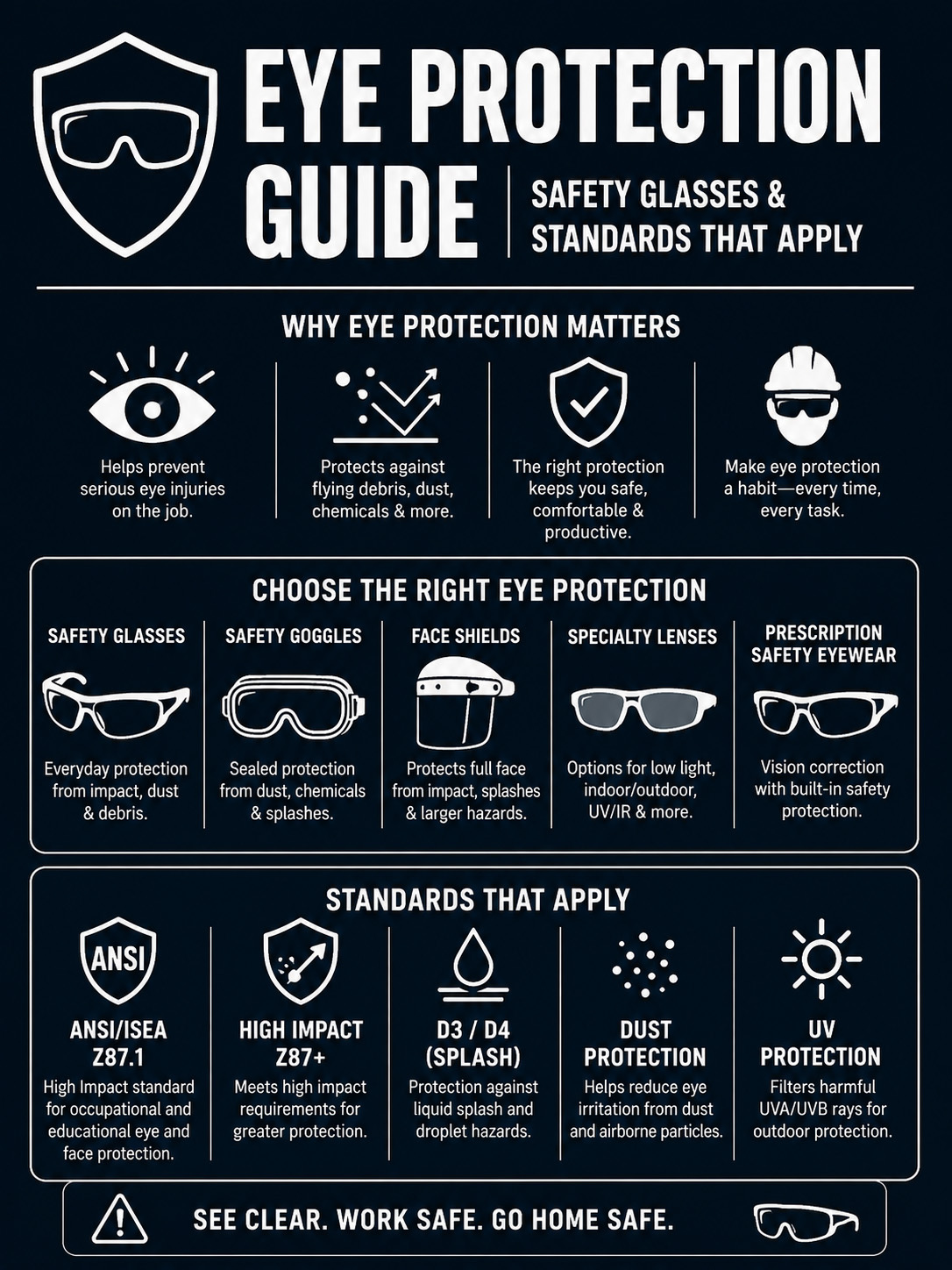
Eye injuries are among the most common workplace incidents in the United States and nearly all of them are preventable with the right protective eyewear. But not every pair of safety glasses is built for every job. A lightweight frameless lens that's perfect for a clean lab environment won't cut it in a grinding or chemical-splash application. Understanding the types of safety glasses available and the standards that certify them is the first step to making sure your crew's eyes are actually protected.
The ANSI Z87.1 Standard: What It Means and What to Look For
All protective eyewear sold for occupational use in the United States is tested and certified under ANSI/ISEA Z87.1, the American National Standard for Occupational and Educational Personal Eye and Face Protection Devices. When you see the Z87 or Z87+ marking stamped on a lens or frame, it tells you the product has been independently tested for impact resistance, optical clarity, coverage, and fit.
The Z87+ designation is the more stringent of the two. The "+" signifies that the lens meets the high-impact ballistic test standard, lenses must survive a steel ball traveling at higher velocity than the basic Z87 test. For most industrial environments, Z87+ is the appropriate minimum. The marking appears directly on both the lens and the frame; if either is missing, the glasses are not compliant.
Additional letter codes on compliant eyewear indicate special properties:
- D3 — Droplet and splash protection (liquid chemical hazards)
- D4 — Dust protection
- D5 — Fine dust protection
- U (1–6) — UV protection scale
- L (1–10) — Visible light filter scale
- V — Photochromic (variable tint) lens
- S — Special purpose tint
OSHA 29 CFR 1910.133 requires employers to ensure workers use eye protection that meets ANSI Z87.1 when there is exposure to flying particles, molten metal, liquid chemicals, acids, caustic liquids, chemical gases, or injurious light radiation. Never accept generic "safety glasses" without verifying the Z87 marking is present on the product itself.
Types of Safety Glasses and When to Use Each
 Full Frame Safety Glasses
Full frame safety glasses wrap a protective lens within a solid, enclosed frame — the most robust single-lens style available. The frame provides structural support and secondary impact protection around the lens perimeter, making this style well-suited to construction, manufacturing, and heavy industrial work where debris impact risk is high. Full frame glasses typically offer better coverage of the brow and temple area than frameless or half-frame styles.
Frameless Safety Glasses
Frameless safety glasses mount directly to the temples without a surrounding frame structure, resulting in an extremely lightweight, unobstructed field of view. They're a popular choice in environments where workers must wear eyewear for extended periods, inspection, warehousing, light assembly, because the reduced weight significantly improves all-day compliance. Frameless models must still carry a Z87+ rating; the absence of a frame does not reduce the lens's impact requirement.
Half-Frame Safety Glasses
Half-frame glasses feature a frame along the top of the lens only, leaving the bottom edge open. This design balances the structural support of a full-frame style with the lighter weight and improved close-up visibility of a frameless option — useful for workers who alternate between distance work and reading tasks without prescription safety eyewear.
Foam Lined Safety Glasses
Foam lined safety glasses add a soft foam gasket around the inner frame perimeter that seals against the face. This seal dramatically reduces the ingress of fine dust, debris, and wind, making foam-lined glasses the choice for grinding, sanding, woodworking, and any dusty environment where standard open-frame glasses leave gaps at the brow, cheek, and temple. They offer the comfort and breathability of glasses with coverage closer to a goggle.
Anti-Fog Safety Glasses
Lens fogging is one of the primary reasons workers remove their eye protection — which defeats the purpose entirely. Anti-fog safety glasses are coated with a chemical treatment that prevents condensation from obscuring the lens in humid environments, during temperature transitions (moving from a cold truck into a warm building), or when worn over a face covering. Most anti-fog coatings are applied to the interior surface of the lens and can be maintained with a damp wipe rather than dry rubbing, which can scratch the coating over time.
Goggles & Over-the-Glass (OTG) Safety Glasses
Goggles and OTG (over-the-glass) safety glasses serve two related but distinct purposes. Chemical splash goggles provide a sealed, indirect-vent enclosure around the eye to prevent liquid splatter from reaching the eye from any angle, required under ANSI D3 applications per 1910.133. OTG glasses are designed with a wider frame to fit comfortably over prescription eyeglasses, making them the practical solution for prescription wearers who don't have dedicated prescription safety glasses. Both styles are Z87.1 compliant and available with anti-fog coatings.
Polarized Safety Glasses
Polarized safety glasses reduce glare from horizontal reflective surfaces, pavement, water, metal, by filtering horizontally oriented light waves. They're most effective for outdoor work in direct sun, driving, and work near water or highly reflective equipment. Polarized lenses are tinted and therefore not appropriate for low-light or indoor use; they're a specialized outdoor-environment tool, not a general-purpose replacement for clear lenses.
Readers / Bifocal Safety Glasses
Bifocal and reader safety glasses incorporate a magnification zone at the bottom of the lens, the same concept as over-the-counter reading glasses, built into a Z87.1 compliant safety frame. They're the practical solution for workers over 40 who need eye protection and close-up magnification for reading gauges, schematics, or fine detail work, without reaching for a separate pair of readers that don't meet safety standards. Available in multiple diopter strengths.
Lens Tints: Matching the Lens to the Light Condition
Lens tint isn't just an aesthetic choice, it's a functional one that directly affects visibility and fatigue:
- Clear — Maximum light transmission; standard for indoor use and low-light outdoor conditions
- Gray/Smoke — True-color rendering in bright light; the most versatile outdoor tint
- Amber/Yellow — Enhances contrast in overcast, hazy, or low-light conditions; popular for dawn and dusk work
- Mirror — High-glare outdoor applications; reduces overall light transmission significantly
- Indoor/Outdoor (I/O) — Lightly tinted lens suitable for transitioning between interior and exterior environments
Crossfire and Pyramex: Trusted Brands at Safety Smart Gear
Safety Smart Gear carries a comprehensive selection of ANSI Z87.1-certified safety glasses from two of the most trusted brands in the industry. Crossfire safety glasses are known for their premium optical clarity, industry-forward styling, and durable polycarbonate lenses — a strong choice for crews who want performance and compliance in the same package. Pyramex safety glasses offer an extensive range of styles and price points, making them a go-to for outfitting large crews with reliable, cost-effective eye protection across multiple task types.
Choosing the Right Eye Protection for Your Job
The right safety glasses depend on a documented hazard assessment of the task, not personal preference. Use this quick reference:
- Impact Hazard (grinding, nailing, chipping) → Full frame or foam-lined, Z87+
- Dust Exposure → Foam-lined or indirect-vent goggle (D4/D5)
- Chemical Splash → Direct-sealed chemical splash goggle (D3)
- Outdoor Glare → Polarized or mirror tint, UV-rated
- Extended Wear / All-Day Use → Lightweight frameless, anti-fog coated
- Prescription Wearers → OTG safety glasses or prescription safety inserts
- Close-up Detail Work → Bifocal/reader safety glasses
Safety Smart Gear stocks a full line of ANSI Z87.1-certified safety glasses across every style and application. For bulk orders, crew outfitting, or help matching the right eyewear to your hazard assessment, contact our team at (508) 248-3141 or use the bulk quote form.