

Heat Stress Relief Clothing & Cooling Products for Work
A Practical Buyer’s Guide for Hot-Weather Jobsites
Cooling vests, neck wraps, hard hat shades, and headbands explained — with OSHA NEP guidance and compliant product recommendations from SafetySmartGear.com.
Why Heat Stress Relief Belongs in Every Summer Safety Plan
Heat is one of the most underestimated hazards on a job site. Unlike a fall or an electrical shock, heat illness builds gradually — a worker can go from “fine” to a medical emergency in the span of an hour, often without realizing it themselves. OSHA does not yet have a finalized federal heat standard, but the agency’s National Emphasis Program (NEP) on heat-related hazards actively directs inspectors to cite employers under the General Duty Clause when preventable heat illness occurs.
The good news: heat stress relief products are inexpensive, easy to implement, and dramatically reduce risk when paired with proper hydration and rest-break policies. This guide walks through the major categories of cooling PPE, how each one works, and which Safety Smart Gear products fit your crew’s specific exposure.
|
☀️ Quick stat: Heat is consistently among the leading causes of weather-related occupational fatalities in the U.S. each year, and the vast majority of heat illness incidents are preventable with basic engineering and administrative controls plus the right PPE. |
Understanding Heat Illness — What Safety Managers Need to Know
Heat-related illness exists on a spectrum, from mild heat cramps to life-threatening heat stroke. Recognizing the progression is critical because the appropriate response changes dramatically as severity increases.
|
Condition |
Symptoms |
Immediate Action |
|
Heat Cramps |
Painful muscle spasms, usually in legs or abdomen, heavy sweating |
Move to shade, rest, hydrate with water or electrolyte drink |
|
Heat Exhaustion |
Heavy sweating, weakness, dizziness, nausea, headache, clammy skin |
Move to cool area, loosen clothing, apply cool water/cloths, hydrate |
|
Heat Stroke |
Confusion, slurred speech, hot/dry or damp skin, very high body temp, possible loss of consciousness |
Call 911 immediately; cool the person rapidly with water/ice while waiting |
|
⚠️ Critical: Heat stroke is a medical emergency. Do not wait to see if symptoms improve — call emergency services immediately and begin active cooling while waiting for help to arrive. |
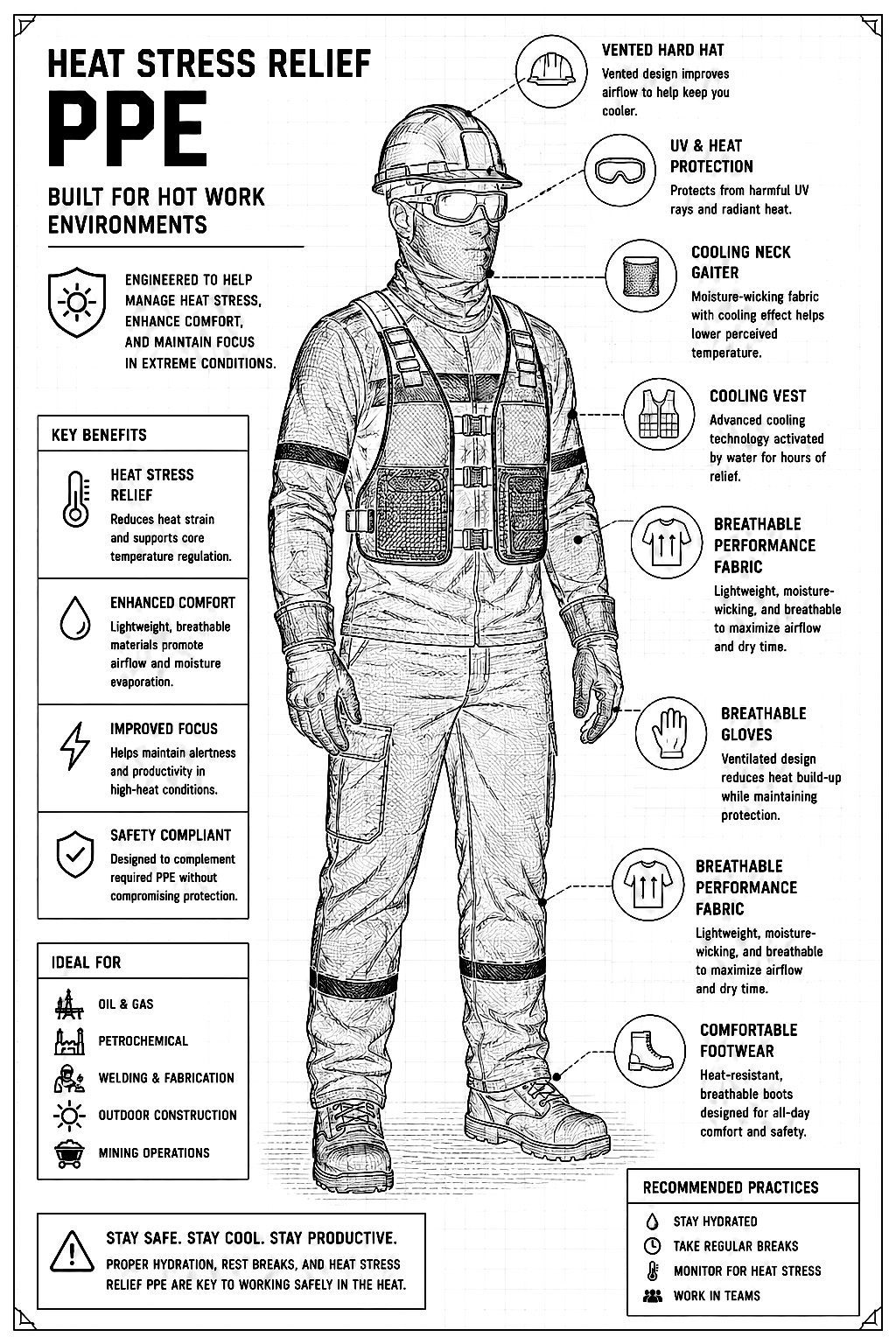
The Hierarchy of Heat Stress Controls
OSHA’s guidance follows a standard hierarchy of controls, and cooling PPE sits at the bottom — it supplements, but never replaces, the controls above it:
- Engineering controls: shade structures, fans, air conditioning in break areas
- Administrative controls: acclimatization schedules, work/rest cycles, scheduling heavy tasks for cooler hours
- Hydration policy: CDC recommends roughly one cup of water every 15–20 minutes during heat exposure
- Cooling PPE: cooling vests, neck wraps, hard hat shades, and headbands — the focus of this guide
|
PRODUCT CATEGORY 1 · Cooling Vests |
Cooling vests are the most effective category of heat stress relief PPE because they cool the body’s core directly — the torso houses major blood vessels, so cooling here has an outsized effect on overall body temperature compared to cooling extremities alone.
How Cooling Vests Work
- Evaporative cooling vests: Made from a moisture-wicking fabric (often PVA or similar polymer) that’s soaked in water before wear. As water evaporates, it pulls heat away from the body. Most effective in low-to-moderate humidity environments.
- Phase-change cooling vests: Contain gel packs or panels that absorb heat as they change from solid to liquid at a specific temperature (often around 58°F). Effective even in high humidity since they don’t rely on evaporation.
- Ice/cold pack vests: Use pockets for ice packs or frozen gel inserts. Strongest initial cooling effect but shortest duration; best for short, high-intensity heat exposure tasks.
Which Cooling Vest Type Fits Your Crew?
|
Product Type |
How It Works |
Cooling Duration |
Best For |
|
Evaporative vest |
Water-soaked fabric cools via evaporation |
2–4 hours |
Dry/moderate climates; outdoor crews with water access |
|
Phase-change vest |
Gel packs absorb heat at fixed melting point |
2–3 hours |
High-humidity environments; warehouse and indoor work |
|
Ice pack vest |
Frozen inserts provide direct cold contact |
1–2 hours |
Short high-intensity tasks; immediate relief during breaks |
|
FR cooling vest |
Same cooling tech in a flame-resistant shell |
2–3 hours |
Utility, oil & gas, and electrical workers needing FR compliance |
Shop Cooling Vests — SafetySmartGear.com
› Heat Stress Relief — Cooling Vests — Evaporative and phase-change cooling vests from PIP, OccuNomix, and Radians
› FR Heat Stress Relief — Flame-resistant cooling products for utility, electrical, and oil & gas crews
|
PRODUCT CATEGORY 2 · Cooling Neck Wraps & Towels |
Neck wraps target one of the body’s most effective heat-exchange zones. The carotid arteries run close to the skin’s surface in the neck, so cooling this area helps lower blood temperature efficiently — with far less bulk and cost than a full cooling vest.
Why the Neck Matters
- Major blood vessels sit close to the skin surface, allowing rapid heat transfer
- Lightweight and unobtrusive — doesn’t interfere with PPE like hard hats, harnesses, or hi-vis vests
- Most styles use the same polymer crystals as cooling vests; soak in water 1–2 minutes, snap to activate, and wear for hours of relief
- Reusable for hundreds of cycles — among the most cost-effective heat relief products available
Shop Cooling Towels & Wraps — SafetySmartGear.com
› Cooling Towels & Neck Wraps — PVA cooling towels and snap-closure neck wraps; reusable, lightweight relief
› FR Neck Gaiters, Tubes & Buffs — Flame-resistant neck coverage that pairs with cooling products for FR-required worksites
|
PRODUCT CATEGORY 3 · Hard Hat Shades & Cooling Headbands |
Two of the simplest, lowest-cost heat relief products are also among the most overlooked: hard hat brim shades and cooling headbands. Both address heat exposure at the head and face, where direct sun exposure significantly increases perceived heat and the risk of heat-related headache or dizziness.
Hard Hat Shades
A hard hat shade is a fabric attachment that clips onto a standard hard hat brim, extending shade coverage to the neck, ears, and face. Workers doing roadway, roofing, or any prolonged direct-sun task benefit significantly from this low-cost addition — it requires no change to existing hard hat compliance and adds negligible weight.
Cooling Headbands
Cooling headbands work the same way as neck wraps — soaked or snap-activated polymer crystals — but are worn under a hard hat or cap to cool the forehead and temples directly. They’re especially popular for workers who sweat heavily into safety glasses or cause fogging in face shields, since the headband helps wick moisture away from the brow line.
Shop Hard Hat Shades & Headbands — SafetySmartGear.com
› Hard Hat Shades & Cooling Headbands — Clip-on hard hat brim shades and snap-activated cooling headbands
› Hard Hats & Liners — ANSI Z89.1 hard hats compatible with shade attachments
Building a Complete Heat Stress Relief Kit
Rather than choosing a single product, most safety managers build a layered kit suited to the severity of heat exposure their crew faces. Here’s a practical framework:
Light Exposure (Occasional Outdoor Tasks)
- Cooling towel or neck wrap for breaks
- Hard hat shade for direct sun tasks
- Standard hydration policy (water every 15–20 minutes)
Moderate Exposure (Regular Outdoor or Warm Indoor Work)
- Evaporative or phase-change cooling vest
- Cooling headband worn under hard hat
- Scheduled rest breaks in shaded or air-conditioned area
Severe Exposure (Sustained High Heat, FR Environments, or Confined Spaces)
- FR-rated cooling vest for arc flash or flash fire environments
- Ice pack vest for short rotation in extreme heat tasks
- Formal acclimatization schedule for new or returning workers
- Buddy system and heat illness monitoring protocol
|
Compliance tip: Even without a finalized federal heat standard, document your heat stress program in writing — including hydration policy, rest schedules, and PPE provided. This documentation is your strongest defense if OSHA’s NEP inspectors visit your site during a heat event. |
Shop Heat Stress Relief at Safety Smart Gear
Safety Smart Gear carries a full line of heat stress relief and cooling PPE from trusted brands including PIP, OccuNomix, and Radians. From evaporative cooling vests to hard hat shades, our products are designed to support OSHA NEP-aligned heat illness prevention programs at a price point that makes outfitting an entire crew affordable.
Browse our full heat stress relief collection: Heat Stress Relief — PPE · FR Heat Stress Relief
Need help choosing the right cooling products for your crew’s specific exposure? Call us at (508) 248-3141 or visit our Customer Support page — our safety specialists are ready to help you build a heat stress program that keeps your team safe all summer long.
Recent Posts
-
FR / Hi-Vis: Dual Protection for High-Risk Work Environments
Flame Resistant / Hi-Vis Clothing: Dual Protection for High-Risk Work Environments When workers face …Jul 22nd 2026 -

Heat Stress Relief Clothing & Cooling Products for Work
A Practical Buyer’s Guide for Hot-Weather Jobsites Cooling vests, neck wraps, hard hat shades, and h …Jun 22nd 2026 -
Mens Workwear Shirts: Durability and Style
In any demanding job, from the construction site to the workshop, the right work shirt is more than …Jun 9th 2026